
Ecological Combat between Anthropocentrism and Ecocentrism in Tim Winton’s Select Novels
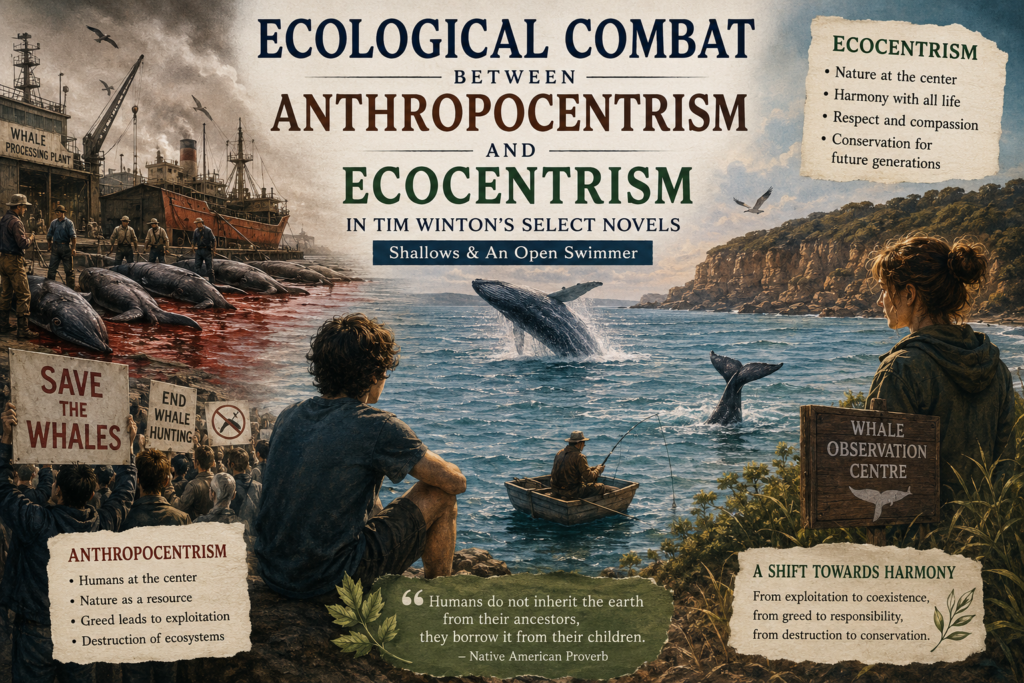
The article studies the environmental ideas found in the novels of Tim Winton, especially Shallows and An Open Swimmer. The research explains how human beings often destroy nature because of greed, modernization, and economic ambition, while some individuals try to protect nature and live in harmony with it. The article mainly discusses the conflict between anthropocentrism and ecocentrism through the characters and themes in these novels.
Introduction
The article begins by discussing the idea of ecocriticism, which is a literary approach that examines the relationship between human beings and nature. Ecocriticism studies how literature represents environmental destruction, human attitudes toward nature, and ecological problems. It argues that humans should not exploit nature only for their personal benefit because such actions reduce biodiversity and damage ecosystems.
The paper then introduces the concept of ethnoecology, which studies how people understand and interact with their surrounding environment. It combines culture, traditions, beliefs, and ecological knowledge. The term consists of two parts:
- “Ethno” refers to people or culture.
- “Ecology” refers to the environment and living organisms.
Ethnoecology includes:
- Ethnobotany – the study of human relationships with plants.
- Ethnozoology – the study of relationships between humans and animals.
The article especially focuses on ethnoichthyology, a branch that studies human relationships with fish and marine life. This field also supports the conservation of marine species and promotes laws against overfishing. The article explains that modernization and cultural development have endangered many marine species, especially whales.
Human Concern for Nature
The article explains that human concern for nature appears in two forms:
- Emotional concern and sympathy for nature.
- Environmental laws and regulations created for protection.
However, only a small number of people truly care about the environment. Most humans are driven by selfishness and economic gain, which leads to the destruction of nature. This creates a conflict between:
- Anthropocentrism – a human-centered worldview.
- Ecocentrism – a nature-centered worldview.
In An Open Swimmer, the protagonist Jerra develops a deep emotional relationship with marine life. He enjoys fishing and dreams of finding a precious pearl inside a huge fish. The pearl symbolizes his search for meaning and purpose in life.
Jerra spends time in nature with his friend Sean and meets an old fisherman who shares stories about whales and fishing. Fishing is shown as a traditional and necessary activity for survival. But the article argues that when human need becomes greed, fishing turns harmful and threatens the ecosystem.
Jerra’s desire to catch large sea creatures for profit represents humanity’s greed. People exploit nature to gain wealth, and this exploitation damages ecological balance. The article suggests that modern cultural development and technological advancement encourage humans to view nature as a source of income instead of respecting it as a living system.
The ocean in the novel symbolizes untouched wilderness. Human interference in this wilderness causes environmental damage. Thus, cultural progress and modernization gradually destroy pure natural spaces.
Ecology and Culture
The article next discusses the connection between ecology and culture in Shallows. Two types of people are portrayed in the novel:
- Those who respect and coexist with nature.
- Those who exploit animals for commercial purposes.
The novel is set in Angelus, a coastal town in Western Australia where whale hunting is a major industry.
Queenie Cookson, one of the main characters, is emotionally attached to whales from childhood. Even though she fears them, she admires and respects them. One childhood memory describes her seeing what appeared to be a whale approaching her house during a storm. This moment reflects the mysterious and powerful relationship between humans and nature.
The article explains that humans and animals share the same world. As population increases, humans invade wilderness areas and begin living in places that originally belonged to animals. Nature remains balanced only when humans coexist peacefully with other living beings.
The paper further explains that modern society transforms natural landscapes into urban settlements. Forests, rivers, and coastal regions are reconstructed for human use. According to the article, this transformation reflects anthropocentric thinking because humans reshape nature for their convenience.
Jerra’s life also reflects this conflict. He feels peaceful near the ocean but uncomfortable in the city. His mother wants him to live a normal social life with work and marriage, but Jerra feels more connected to the sea. The sounds of nature that once comforted him are replaced by traffic and machinery, showing how modernization separates humans from nature.
Anthropocentric Approach
The article explains that Shallows strongly presents an anthropocentric attitude toward nature. In the novel, whales are hunted and slaughtered by the Paris Bay Whaling Industry for commercial purposes.
Queenie becomes disturbed when whales stop appearing near the coast. She later discovers that many whales are being killed in the whaling industry. Inside the factory, she witnesses bloodshed and cruelty. Protestors gather outside the factory demanding an end to whale hunting.
The article emphasizes that whales are important to marine ecosystems and should not be treated merely as products for profit. Humans threaten whales even though whales do not threaten humans.
Anthropocentrism places humans above all other living beings. In this hierarchy:
- Humans occupy the central position.
- Nature exists only to serve human needs.
This mindset leads to exploitation of animals and natural resources. Historically, hunting was done mainly for survival and protection. But in modern society, technology and greed have transformed hunting into a commercial business.
The article also refers to the theory of Oikopoetics by Nirmal Selvamony. According to this idea, modern materialistic society treats nature as an object for investment and profit. Industries kill whales for oil, flesh, and bones without considering ecological consequences.
Corporate industries focus only on economic growth and ignore the future impact on the environment. Thus, human greed becomes the main cause of environmental destruction.
Ecocentric Approach
The article then shifts to ecocentrism, which places nature at the center instead of humans. Ecocentric thinking encourages humans to live in harmony with the environment.
Environmental activists and eco-critics begin to realize the consequences of exploiting nature. Natural disasters and ecological imbalance force people to rethink their actions. As awareness grows, people attempt to rebuild and protect the environment.
In Shallows, Queenie and environmental activists organize protests against the whaling industry. They fight to save whales from extinction and argue that whales are essential for ocean health.
The article mentions a proposal to transform the whaling station into a whale observation center, similar to conservation programs in the United States. Instead of killing whales, tourists and students could observe them in their natural habitat. This would protect whales while still providing employment opportunities.
Eventually, the anti-whaling movement succeeds. Queenie becomes happy when whales return to the coast, and she feels hopeful that future generations will also witness them alive in the ocean.
Similarly, in An Open Swimmer, Jerra experiences a transformation in his attitude toward marine life. He catches a large fish and initially wants to cut it open to search for a pearl. However, when he sees the suffering creature, he feels emotional and guilty. Instead of killing it for profit, he wishes the fish could live again.
This moment symbolizes the awakening of ecocentric consciousness. Jerra realizes that living beings should not be destroyed merely for human benefit.
The article argues that fishing itself is not wrong because it is necessary for livelihood. But when greed controls human actions, fishing becomes destructive hunting. Emotional understanding and compassion toward nature can prevent environmental damage.
Conclusion
The article concludes that human greed and the desire for economic growth are the major causes of environmental destruction. In both novels:
- Jerra seeks a pearl for wealth.
- Whalers kill whales for commercial products.
These actions reflect anthropocentric thinking, where nature is treated as a tool for profit.
However, the article also shows a gradual shift from anthropocentrism to ecocentrism. Characters like Queenie and Jerra begin to understand the importance of protecting nature. Their emotional connection with animals leads them toward environmental awareness.
The study argues that humans should adapt themselves to nature rather than forcing nature to adapt to human desires. Population growth, urbanization, and technological advancement threaten ecosystems and animal habitats.
Ultimately, the article supports the idea that humans and nature must coexist peacefully. Ecocentrism is presented as the better approach because it values all living beings equally and aims to preserve nature for future generations.
Through Shallows and An Open Swimmer, Tim Winton illustrates the cultural and ecological transformation from human-centered thinking to environment-centered thinking.
https://en.wikipedia.org/wiki/Tim_Winton

100 ICT & AI Abbreviations Every Student Should Know
100 ICT Abbreviations a Every Student Should Know 100 ICT Abbreviations-The worlds of Information and…

Mastering English Grammar in 30 Days: The Best Guide
Learn how to mastering English grammar quickly with this 30-day accelerated plan. Focus on practice,…
Ecological Combat Between Anthropocentrism and Ecocentrism in Tim Winton’s Select Novels
Ecological Combat between Anthropocentrism and Ecocentrism in Tim Winton’s Select Novels The article studies the…
neet on feet
Master the NEET Exam with Confidence Achieving a top score in the National Eligibility cum…

Welcome to Jeno NEET Prep
Master the NEET Exam with Confidence Achieving a top score in the National Eligibility cum…
PHONOLOGICAL INFLUENCES IN SECOND LANGUAGE LEARNING, REMEDIAL STRATEGIES, AND RECOMMENDATIONS FOR COLLEGE STUDENTS
https://www.johnfoundation.com/wp-content/uploads/2024/10/SIJMRS_V7I3_116.pdf